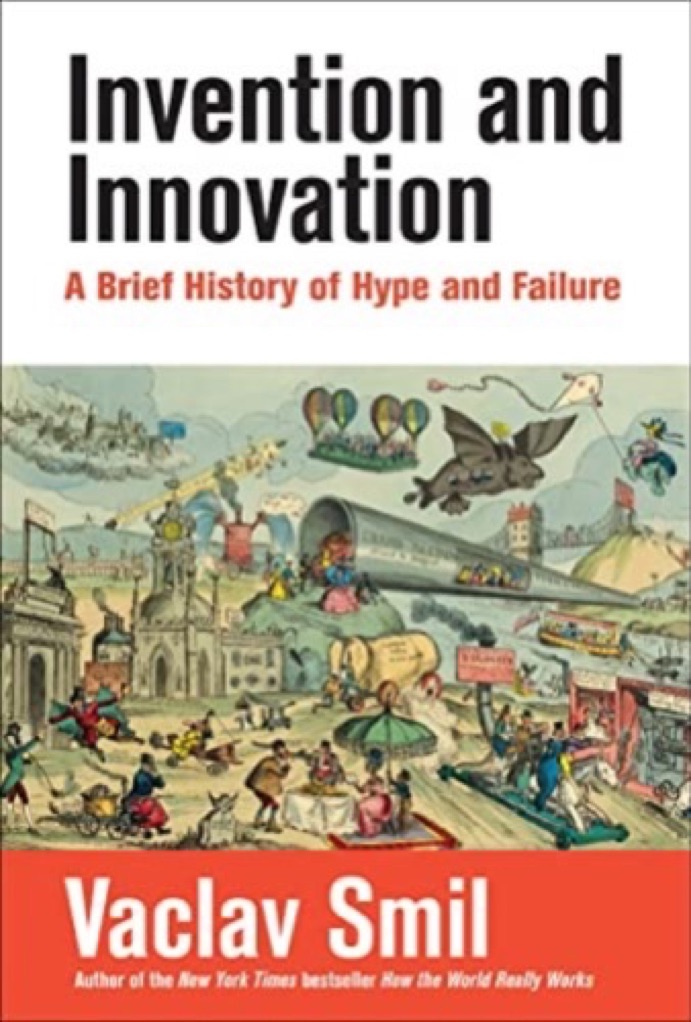
Invention and Innovation: A Brief History of Hype and Failure
Applying the lessons from "Invention and Innovation" by Vaclav Smil to your life can be a transformative exercise in developing a "skeptical optimist" mindset, especially for someone navigating the high-stakes intersections of medicine, law, and venture capital. Here are some ways you might integrate these lessons:
- Distinguish Between Novelty and Utility in Business: - In your roles as a venture capitalist and serial entrepreneur, you must look beyond the initial "invention" or the slick pitch deck to evaluate true innovation potential. Ask whether a new healthcare technology solves a fundamental physical or economic problem, or if it is merely a digital skin on an inefficient process, ensuring your capital is directed toward solutions that can truly scale within the complex medical landscape.
- Anticipate Second-Order Effects in Leadership: - Drawing on your medical and legal background, adopt Smil’s habit of looking for potential "disastrous successes." When evaluating a new business model or medical protocol, rigorously analyze the potential for unintended consequences—whether environmental, social, or physiological—to avoid the modern-day equivalents of leaded gasoline or toxic industrial shortcuts.
- Respect the Inertia of Large-Scale Systems: - Whether managing a multi-state healthcare system or piloting an aircraft, recognize that large-scale change takes significantly more time and energy than public discourse suggests. Use Smil's data-driven realism to set more accurate timelines for your ventures, resisting the urge to succumb to the "hype cycle" that often leads to premature scaling and eventual failure.
- Adopt a "Hard Tech" Realism to Problem Solving: - As a pilot and engineer at heart, lean into the physical constraints of the world rather than just the digital possibilities. Smil’s focus on energy density serves as a reminder that software cannot solve every problem; true progress in fields like Tribal Health or urgent care often requires physical, logistical, and human-centric innovations that respect the laws of thermodynamics and human behavior.
- Cultivate Intellectual Humility as a Polymath: - Smil’s critique of "techno-hype" aligns perfectly with your mantra of staying humble. By acknowledging that even the most brilliant inventions can fail due to unforeseen complexities, you can lead your teams with a grounded perspective that values steady, incremental improvement and historical context over the search for a non-existent "silver bullet."
By integrating these lessons, you will become a more effective leader and investor who isn't swayed by the transient noise of the "new," but is instead focused on the enduring, difficult work of building innovations that provide lasting value to society and the patients you serve.
What the book covers
"Invention and Innovation: A Brief History of Hype and Failure" by Vaclav Smil is a rigorous critique of the contemporary obsession with "disruptive" technology and the frequent conflation of new ideas with successful market integration. Smil, a prolific polymath known for his data-driven analysis of energy and materials, uses historical evidence and physical laws to demonstrate that while human ingenuity is boundless, the path from a patent to a world-changing product is fraught with insurmountable hurdles. The book serves as a sobering corrective to the techno-optimism prevalent in venture capital and Silicon Valley, reminding readers that many of our most lauded modern "advancements" are actually incremental or, in some cases, detrimental to long-term global stability.
Summary:
- Defining the Gap Between Invention and Innovation: - Smil clarifies that "invention" is the creation of a new device or process, while "innovation" is the successful, large-scale adoption of that invention. He argues that the modern world suffers from an "innovation fatigue," where the term is applied to every minor software update, obscuring the fact that fundamental breakthroughs in energy, transportation, and materials have actually slowed significantly since the mid-20th century.
- The History of Technically Feasible but Failed Inventions: - The author examines inventions that were technically brilliant but failed to achieve widespread use, such as the vacuum tube train or commercial airships. Through these examples, he demonstrates that technical feasibility is insufficient for market success; an invention must also be economically viable, safe, and significantly superior to existing alternatives to transition into a true innovation.
- The High Cost of Disastrous Successes: - Smil provides a chilling account of innovations that were highly successful in terms of adoption but ultimately catastrophic, such as leaded gasoline, DDT, and chlorofluorocarbons (CFCs). He highlights how these technologies were hailed as miracles before their toxic long-term environmental and health impacts were understood, serving as a warning for current "breakthroughs" that are deployed without adequate long-term risk assessment.
- The Persistent Hype Surrounding Nuclear Fusion: - A significant portion of the book is dedicated to the "forever thirty years away" promise of nuclear fusion. Smil analyzes the immense engineering challenges involved in containing plasma at stellar temperatures, arguing that the hype surrounding fusion often ignores the practical realities of building and maintaining such complex industrial infrastructure in a way that is commercially viable.
- The Slower-Than-Expected Global Energy Transition: - Contrary to popular belief that the world can transition to a carbon-free economy in a decade or two, Smil emphasizes the massive inertia of global energy systems. He explains that the energy density of fossil fuels and the existing trillion-dollar infrastructure make the "innovation" of a green grid a much longer, multi-generational process than politicians and investors suggest.
- The Decoupling of Digital Progress and Physical Reality: - While acknowledging the rapid growth in microchip density, Smil argues that digital progress has not translated into similar leaps in the physical world. He points out that commercial air travel speeds have remained stagnant since the 1960s and that we still rely on 19th-century concepts for much of our heavy industry, suggesting that our current era is one of refinement rather than revolution.
The book’s significance lies in its insistence on physical and economic realism in an era of hyperbolic marketing. By stripping away the "tech-bro" veneer, Smil provides a foundational text for understanding why real progress is slow, difficult, and often carries hidden risks that require a more humble approach to human ingenuity.