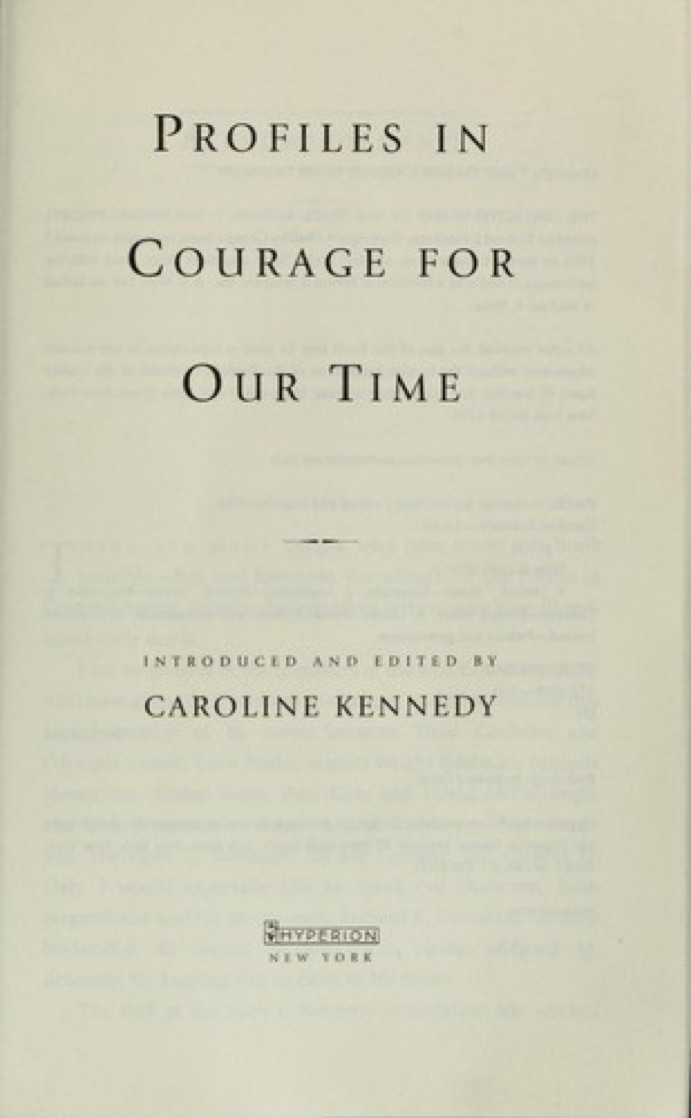
Profiles in Courage for Our Time
Applying the lessons from "Profiles in Courage for Our Time" by Caroline Kennedy to your life can be a transformative exercise in identifying your own moral compass and the price you are willing to pay for your principles. Here are some ways you might integrate these lessons:
-
Defining Your "Non-Negotiables": - In both the medical field and the boardroom, you will face moments where the easy path conflicts with the right path. You must proactively define your core values before the crisis hits, ensuring that when you are pressured by stakeholders or institutional inertia, you have a pre-established internal anchor to guide your decisions.
-
Embracing the Lonely Vote: - Whether you are an attorney arguing an unpopular but just case or a venture capitalist backing a contrarian idea, you must become comfortable with dissent. Real progress often requires being the lone voice in the room, and as the profiles show, the most significant historical shifts often begin with a single person’s refusal to go along with a misguided consensus.
-
Prioritizing Long-Term Integrity Over Short-Term Gain: - For the serial entrepreneur, the temptation to take shortcuts for quick exits or immediate profits is constant. You should apply the lessons of these political figures by focusing on the "long game"—understanding that a reputation for integrity and courageous decision-making is a more valuable asset over a career than any single transaction.
-
Navigating Risk with Mental Discipline: - As a pilot, you understand that risk must be managed through discipline and preparation. Similarly, in leadership, courage is not about being reckless; it is about taking calculated risks for a worthy cause. You can integrate this by meticulously assessing the "why" behind your risks, ensuring they serve a mission larger than your own ego.
-
Cultivating Resilience Under Fire: - The figures in the book faced public ridicule and professional exile for their stances. You can apply this by building the emotional and mental resilience necessary to withstand criticism. In any high-stakes field like emergency medicine or venture capital, you will face internal pushback; true courage is found in the ability to stay the course once you are certain of your moral direction.
-
Championing Integrity in Others: - Following the "Stay Humble" mantra, you can use your platform to highlight and support courage in others. Just as Kennedy cataloged these stories to inspire readers, you should look for opportunities to champion the junior associate, the resident, or the young founder who has the guts to speak truth to power, fostering a culture where integrity is rewarded.
By integrating these lessons, you ensure that your legacy is defined not just by your professional accolades or financial successes, but by the strength of your character during the moments that truly mattered. By choosing courage over convenience, you honor the high standards of leadership and service required to make a lasting impact on the world.
What the book covers
"Profiles in Courage for Our Time" by Caroline Kennedy is a compelling anthology that updates the spirit of her father’s Pulitzer Prize-winning work for the modern era. The book features essays by prominent writers and journalists who profile recipients of the Profile in Courage Award, which honors public officials who act according to their conscience despite the risk to their careers. It serves as both a historical record of contemporary political bravery and a call to action for citizens to demand integrity from their leaders.
Summary:
-
The Evolution of Political Courage: - The book opens by establishing the criteria for the Profile in Courage Award, emphasizing that courage is not merely the absence of fear but the decision to act on principle regardless of the personal or political consequences. It connects the 1956 original work to the complexities of the late 20th and early 21st centuries, noting that while the issues have changed, the fundamental pressure to conform remains just as intense.
-
John Lewis and the Pursuit of Justice: - One of the most powerful essays details the life of Congressman John Lewis, focusing on his unwavering commitment to civil rights and voting equality. The narrative explores how Lewis repeatedly risked his life and his political standing to challenge systemic racism, illustrating that courage often requires a long-term commitment to a cause that may take decades to see fruition and acceptance by the mainstream.
-
John McCain and the Spirit of Reform: - The profile of Senator John McCain highlights his work on campaign finance reform, specifically the McCain-Feingold Act. This section examines the immense pressure McCain faced from within his own party and the financial interests of Washington, showing how he prioritized the integrity of the democratic process over partisan loyalty and the personal fundraising advantages that the status quo provided.
-
Russell Feingold’s Principled Dissent: - The book examines Senator Russ Feingold’s decision to be the lone vote in the Senate against the USA PATRIOT Act in the immediate wake of the 9/11 attacks. This chapter delves into the intense atmosphere of national fear and the immense political risk Feingold took by standing up for civil liberties when the country was overwhelmingly focused on security, providing a masterclass in intellectual independence.
-
Courage in Local and State Governance: - Beyond national figures, the book highlights individuals like Corky Gonzales and Charles Price, who demonstrated courage in more localized settings. These stories emphasize that political bravery is not reserved for the halls of Congress but is equally vital in judicial decisions, local school boards, and state legislatures where the personal stakes and community pressure can be even more immediate and intense.
-
Integrity Against the Partisan Tide: - A recurring theme across the essays is the difficulty of bucking one's own party. The contributors argue that the most difficult form of courage in the modern era is often found when a leader breaks rank to do what is right for the country, illustrating that true leadership often requires alienating one's most vocal supporters to serve a broader, often silent, constituency.
-
The Enduring Power of Moral Example: - The final sections reflect on how these individual acts of courage create a ripple effect throughout society. By documenting these stories, Kennedy and the contributors argue that identifying and celebrating such bravery is essential for the health of a democracy, as it provides a roadmap and inspiration for future generations of leaders and citizens.
"Profiles in Courage for Our Time" is a vital reminder that the health of a democracy depends on the moral fortitude of its representatives. By bridging the gap between the mid-century challenges described by JFK and the modern dilemmas of the 21st century, the book reinforces the idea that while political landscapes shift, the necessity for individuals to stand by their convictions remains the ultimate safeguard of freedom and justice.