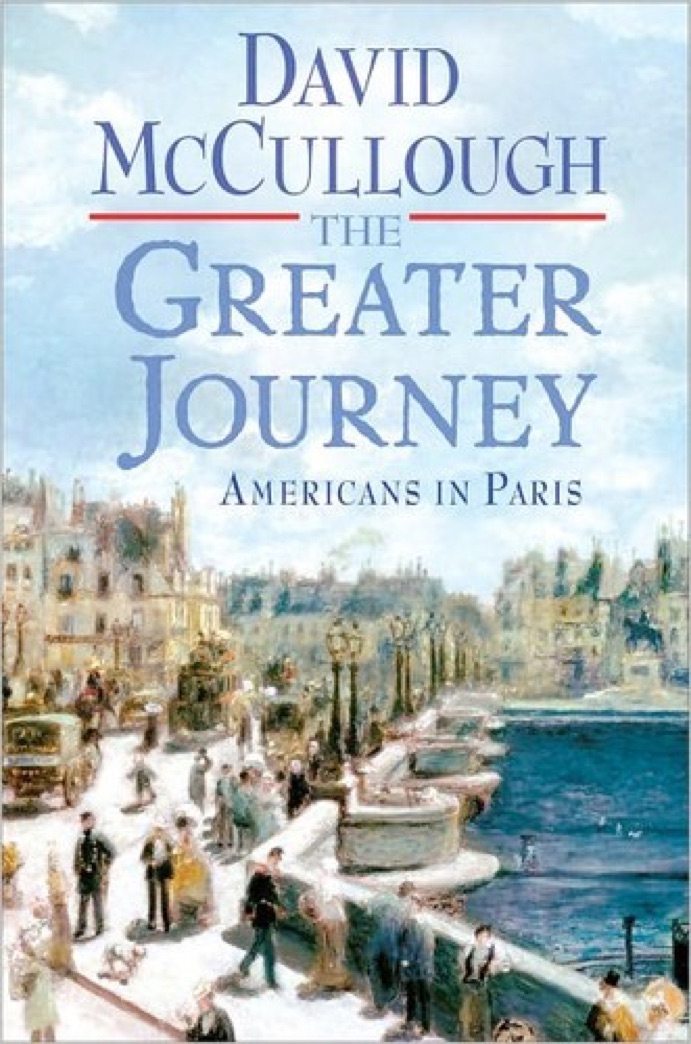
The Greater Journey: Americans in Paris
Applying the lessons from "The Greater Journey: Americans in Paris" by David McCullough to your life can be a transformative exercise in seeking excellence and broader perspective. Here are some ways you might integrate these lessons:
-
Seek World-Class Mentorship: - Just as the medical students of the 1830s sought out Pierre Louis in Paris, you should identify the "gold standard" in your current field and go to any lengths to learn from those practitioners. Whether in medicine or venture capital, settling for local excellence is a recipe for stagnation; true growth requires immersion in environments where the bar is set highest.
-
Embrace the Interdisciplinary Edge: - Samuel Morse was a painter whose visual perspective informed his technological breakthroughs. You can apply this by looking outside your primary silo—be it law, aviation, or entrepreneurship—to find solutions to complex problems. Often, the most innovative ideas come from the intersection of two seemingly unrelated disciplines.
-
Maintain Leadership Integrity Under Pressure: - Elihu Washburne’s refusal to abandon his post during the Siege of Paris serves as a model for crisis management. When your organization or medical practice faces a "siege," your physical presence and unwavering commitment are the primary anchors for your team’s morale and the mission's success.
-
Pioneer New Paths Despite Resistance: - Elizabeth Blackwell had to cross an ocean to find the training she was denied at home. In your own career, when you encounter systemic barriers, do not view them as the end of the road but as a prompt to seek a different "geography" or market where your potential can be realized and refined.
-
Commit to Long-Form Mastery: - The artists and sculptors featured in the book spent years in drafty studios and grueling apprenticeships for the sake of one masterpiece. In an era of "quick wins," you should double down on the "stay hungry" mindset, recognizing that true mastery of a craft—be it surgery, flying, or building a company—takes a lifetime of dedicated, incremental improvement.
-
Adopt a Global Perspective: - These Americans returned home with a broader view of what was possible for their country. By traveling and engaging with different cultures and systems, you gain the humility to recognize that your current way of doing things is not the only way, allowing you to bring back the best global practices to your local endeavors.
By integrating these lessons, you cultivate a life defined by "The Greater Journey"—the continuous pursuit of intellectual and spiritual expansion. Just as these 19th-century Americans returned to build a more sophisticated and capable nation, your own explorations into new disciplines and challenging environments will provide the tools to build more resilient organizations and a more meaningful personal legacy.
What the book covers
"The Greater Journey: Americans in Paris" by David McCullough is a sweeping historical narrative that explores the transformative experiences of American intellectuals, artists, and innovators in 19th-century France. The book chronicles the lives of figures such as James Fenimore Cooper, Samuel Morse, and Elizabeth Blackwell as they sought out the refinement, training, and inspiration they could not find in the young United States between 1830 and 1900. McCullough demonstrates how these individuals returned home to reshape American culture, medicine, and technology, fundamentally altering the trajectory of their nation through the lessons learned abroad. It is a testament to the power of curiosity and the pursuit of excellence through immersion in a world-class environment.
Summary:
-
The Quest for Excellence: - In the mid-19th century, Paris was the undisputed center of the civilized world, offering a depth of history, art, and scientific rigor that America lacked. Figures like James Fenimore Cooper and Samuel Morse moved their families to France not to escape their young nation, but to find the "higher finish" and classical training required to elevate American culture to international standards.
-
The Revolution in Medical Science: - American medicine in the 1830s was largely primitive, relying on "heroic" measures like bloodletting; however, Paris offered a new clinical approach based on observation and data. Students like Oliver Wendell Holmes studied under the great Pierre Louis, returning to the U.S. to advocate for more scientific, empathetic, and evidence-based medical practices that would eventually modernize American healthcare.
-
Artistic Mastery and the Louvre: - For aspiring artists like George P.A. Healy and later Mary Cassatt, the Louvre served as a primary classroom where they could study the masters firsthand. This immersion allowed them to transcend the stiff portraiture of their homeland, leading to a blossoming of American art that could finally compete on the global stage, eventually birthing the American Impressionist movement.
-
The Intersection of Art and Technology: - Samuel Morse’s journey is highlighted as a pivot point where artistic ambition met technological innovation. While in Paris to paint his masterpiece, "Gallery of the Louvre," he was exposed to European scientific discourse that ultimately sparked his transition from painter to the inventor of the telegraph, proving that multidisciplinary exposure is often the catalyst for breakthrough innovation.
-
Sculpting the American Identity: - Augustus Saint-Gaudens arrived in Paris as a young cameo-cutter and left as a master sculptor after rigorous training at the École des Beaux-Arts. His ability to fuse French technical skill with American themes resulted in some of the United States' most iconic public monuments, including the Shaw Memorial and the Sherman Monument, which redefined how the nation memorialized its heroes.
-
Resilience During the Siege: - The book vividly portrays the Siege of Paris and the subsequent Commune through the eyes of Elihu Washburne, the American Minister to France. Washburne remained at his post when others fled, providing a masterclass in diplomatic leadership and humanitarian courage while documenting the collapse of the Second Empire and the birth of the Third Republic.
-
Breaking Gender Barriers: - Elizabeth Blackwell, the first woman to receive a medical degree in the United States, traveled to Paris to gain the surgical experience denied to her at home. Her time at the Maternité hospital was grueling and physically costly, yet it solidified her expertise and resolve, paving the way for future generations of women in the medical profession.
McCullough’s work highlights that the American "Golden Age" was not an isolated phenomenon but the result of a profound global exchange of ideas. By following these pioneers across the Atlantic, we see how exposure to rigorous standards and historical depth allowed a young nation to find its own voice and professionalize its institutions. The book serves as a reminder that growth often requires leaving one’s comfort zone to learn from the masters of a craft, transforming personal ambition into national progress.