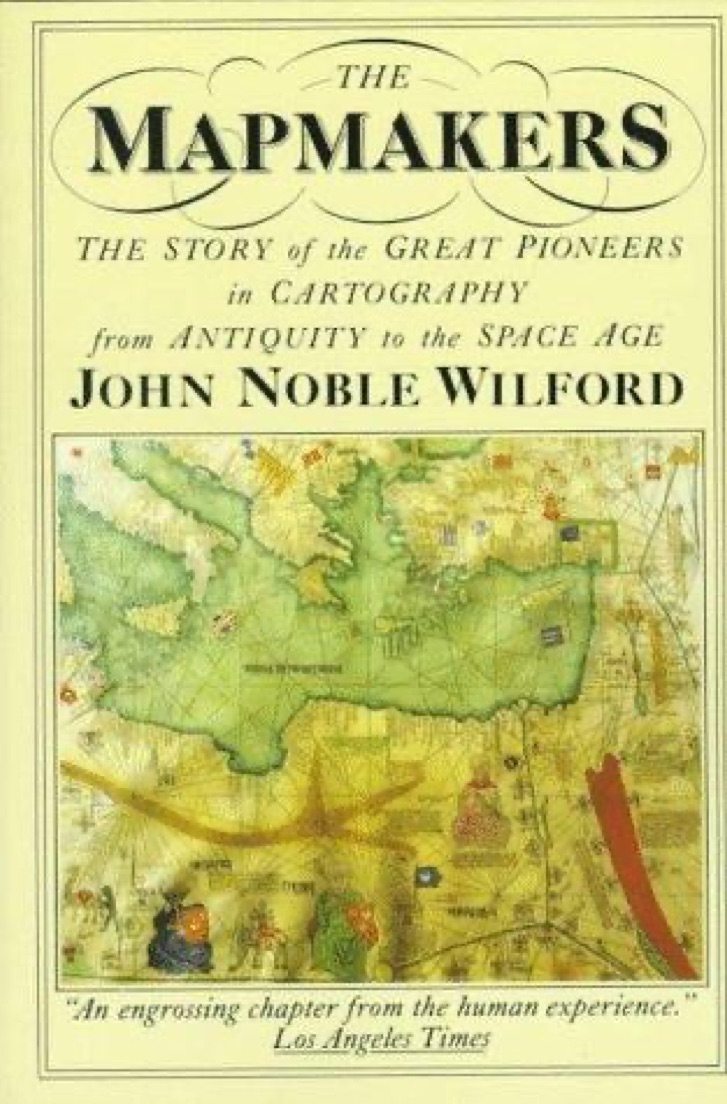
The Mapmakers: The Story of the Great Pioneers in Cartography - from Antiquity to the Space Age
Applying the lessons from "The Mapmakers" by John Noble Wilford to your life can be a powerful way to frame your journey as a leader, professional, and explorer of new frontiers. Here are some ways you might integrate these lessons:
-
Embrace the Iterative Process of Discovery: - Just as early cartographers had to constantly redraw their maps as new data arrived, you should treat your business models or medical protocols as living documents. Do not be discouraged when your initial "map" of a project is proven wrong; instead, view the refinement of your strategy as a necessary step toward absolute precision and success.
-
Master the Tools of Your Trade: - The solution to the longitude problem required a specific technical breakthrough—the chronometer. In your various roles, whether in aviation, law, or medicine, identify the "longitude problem" in your field and seek out or develop the specific technology or skill set that provides the definitive solution rather than relying on outdated or imprecise methods.
-
Think in Multi-Generational Timelines: - The Great Trigonometrical Survey of India outlasted its founders, yet it succeeded because of their rigorous groundwork. When building companies or VC firms, aim to establish systems and cultures that are robust enough to continue the "mapping" of your vision long after you have moved on to the next venture.
-
Maintain Intellectual Humility in the Face of New Data: - The scientists who traveled to Lapland and Peru were willing to endure extreme hardship to prove or disprove a theory. You must remain humble enough to let data dictate your direction, even if it contradicts your previous assumptions or requires you to dismantle a long-held belief about your industry or personal trajectory.
-
Leverage Perspective to Identify New Frontiers: - The shift from ground-level surveying to satellite imagery changed everything because it provided a new perspective. In leadership, frequently step back from the daily "ground-level" operations to view your organization from a "satellite" level, identifying gaps in the market or systemic inefficiencies that are invisible from the trenches.
-
Recognize the Value of Precision and Persistence: - Mapmakers spent years measuring tiny increments of the Earth's surface to create a whole picture. In your entrepreneurial and medical pursuits, remember that massive achievements are built on the back of meticulous, often tedious, work; do not skip the small measurements if you want the final map to be accurate.
By integrating these lessons, you transform your career and personal growth into a disciplined expedition, ensuring that your life's work contributes to a clearer understanding of the world for those who follow in your footsteps.
What the book covers
"The Mapmakers: The Story of the Great Pioneers in Cartography - from Antiquity to the Space Age" by John Noble Wilford is a sweeping and authoritative chronicle of humanity’s quest to measure, describe, and visualize the world. Wilford, a two-time Pulitzer Prize winner, masterfully weaves together the scientific, political, and personal narratives of the visionaries who transformed cartography from speculative art into a rigorous science. The book serves as a testament to the enduring human spirit of exploration and the technological leaps that have allowed us to define our place in the universe.
Summary:
-
The Foundations of Ancient Cartography: - Wilford begins by exploring the early Greek contributions to the field, highlighting the intellectual leaps made by figures like Eratosthenes, who calculated the Earth's circumference with startling accuracy, and Ptolemy, whose "Geography" established a coordinate system that would influence mapmakers for over a millennium. These early sections emphasize that mapping began as a philosophical and mathematical challenge long before the tools existed to verify the data.
-
The Renaissance and the Age of Discovery: - The narrative shifts to the era of global exploration, where the demands of trade and empire-building drove rapid advancements in mapmaking. Wilford details how the rediscovery of ancient texts, combined with the invention of the printing press and the development of Portolan charts, allowed navigators like Columbus and Magellan to push into the unknown, requiring constant updates to the world's perceived boundaries.
-
Solving the Longitude Problem: - A central pillar of the book is the technical evolution of navigation, specifically the centuries-long struggle to determine longitude at sea. Wilford provides a gripping account of John Harrison’s invention of the marine chronometer, illustrating how a single mechanical breakthrough could solve a problem that had previously led to countless shipwrecks and stunted global expansion.
-
Geodesy and the Shape of the Earth: - The book covers the 18th-century scientific rivalries regarding whether the Earth was an oblate or prolate spheroid. Wilford recounts the grueling expeditions to Lapland and Peru led by the French Academy of Sciences, demonstrating the physical toll and extreme dedication required to measure the planet’s curvature and refine our understanding of its true shape.
-
The Great Trigonometrical Survey of India: - Wilford describes the massive, decades-long undertaking to map the Indian subcontinent with mathematical precision. This section highlights the logistical brilliance of William Lambton and George Everest, who used giant theodolites and complex triangulation to map thousands of miles of varied terrain, eventually measuring the height of the world’s tallest peaks.
-
The Transition to Remote Sensing and Satellites: - The final sections move into the 20th and 21st centuries, tracing the shift from ground-based surveying to aerial photography during the World Wars and finally to space-based mapping. Wilford explains how technologies like Landsat, GPS, and radar have allowed us to map not only the Earth's surface but also the ocean floor and the surfaces of other planets with centimeter-level accuracy.
By documenting the transition from parchment to pixels, Wilford illustrates that maps are more than just tools for navigation; they are reflections of our expanding consciousness. The book underscores that the history of cartography is, in essence, the history of human progress and our relentless drive to turn the unknown into the known.