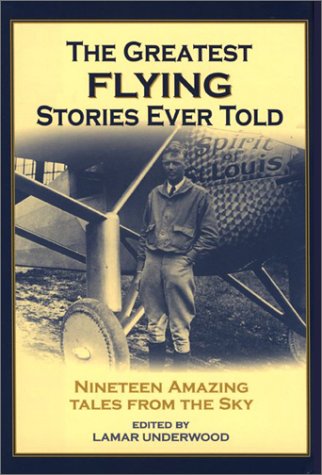
The Greatest Flying Stories Ever Told: Nineteen Amazing Tales from the Sky
Applying the lessons from "The Greatest Flying Stories Ever Told" by Lamar Underwood to your life can be a powerful way to refine your approach to risk, leadership, and personal mastery. Here are some ways you might integrate these lessons:
-
Develop an Instrument-Rated Mindset: - In both medicine and entrepreneurship, there are times when your gut feeling or "spatial orientation" will mislead you due to stress or external pressure. You must learn to trust your "instruments"—data, checklists, and established protocols—to navigate through the fog of a crisis, ensuring that objective reality guides your decision-making rather than temporary emotion.
-
Embrace the Loneliness of Command: - Much like Beryl Markham or Charles Lindbergh over the Atlantic, leadership often requires you to exist in a space where the final decision rests solely on your shoulders. You should cultivate the mental stamina to operate in this isolation, building the self-reliance necessary to sustain your course when there is no external validation or immediate support available.
-
Respect the System and the Environment: - The stories of pilots battling the elements serve as a reminder to "Stay Humble" in the face of complex systems, whether they are biological, legal, or economic. You must recognize that you do not control the environment; you only control your preparation and your response to it, requiring a constant state of vigilance and respect for the forces at play.
-
Practice Iterative Resilience: - The Wright brothers’ success was built on a series of failures and minor adjustments. In your ventures, you should view every setback as a data point that informs your next "flight," understanding that breakthrough innovation is rarely a single event but rather the result of relentless, disciplined experimentation and the courage to get back into the cockpit.
-
Cultivate Symbiotic Mastery: - Just as the best pilots understand the mechanical nuances of their aircraft, you should strive for a deep, intuitive understanding of the tools and teams you lead. Whether it is a medical device, a legal framework, or a venture capital portfolio, true excellence comes from knowing the limits and capabilities of your machinery so well that you can anticipate problems before they manifest.
-
Prioritize the Narrative of the Journey: - Aviation is as much about the stories we tell as the miles we fly. You should recognize the power of storytelling in leadership and legacy, using your experiences to mentor others and humanize the technical rigors of your various professional fields.
By integrating these lessons, you can transform the way you view challenges, shifting from a mindset of survival to one of purposeful exploration. Just as the aviators in this collection found clarity and meaning in the sky, you can find a higher perspective in your own professional and personal life by maintaining the discipline, humility, and hunger required to soar.
What the book covers
"The Greatest Flying Stories Ever Told: Nineteen Amazing Tales from the Sky" edited by Lamar Underwood is a curated anthology that captures the visceral thrill, psychological depth, and historical significance of human flight. The collection assembles a diverse array of perspectives, ranging from the technical logs of the Wright brothers to the philosophical musings of Antoine de Saint-Exupéry and the harrowing combat narratives of World War II. By blending first-hand accounts with literary reflections, the book serves as a comprehensive tribute to the evolution of aviation and the indomitable spirit of those who conquered the third dimension.
Summary:
-
The Dawn of Powered Flight: - The collection begins with the foundational moments of aviation, including the precise, almost clinical accounts of the Wright brothers’ early experiments at Kitty Hawk. These narratives emphasize that the birth of flight was not merely an act of bravery but a result of rigorous engineering, iterative testing, and the refusal to accept gravity as an absolute limitation.
-
The Metaphysics of the Clouds: - Through the inclusion of writers like Antoine de Saint-Exupéry, the book explores the spiritual and philosophical impact of looking down at the earth from a cockpit. These sections argue that flight provides a unique vantage point on the human condition, forcing pilots to confront their own insignificance and the fragile beauty of civilization while navigating the vast, indifferent stretches of desert or sea.
-
Pioneering Solo Endurance: - Significant attention is given to the era of long-distance records, highlighting the extreme mental and physical tolls of early transoceanic flight. Featured accounts from Charles Lindbergh and Beryl Markham detail the sensory deprivation, the hallucinated fatigue, and the sheer willpower required to navigate without modern instruments over featureless horizons, illustrating the isolation inherent in high-stakes exploration.
-
Combat and the Crucible of War: - Several stories focus on the intense reality of aerial warfare, from the open-cockpit dogfights of the First World War to the high-altitude bomber missions of the Second. These accounts move beyond mere action to examine the camaraderie among crews and the cold, technical precision required to survive when the environment itself—and not just the enemy—is lethal.
-
The Battle Against the Elements: - A recurring theme throughout the anthology is the pilot’s relationship with weather, which acts as the ultimate antagonist. Stories describing flights through typhoons and blinding snowstorms highlight the transition from intuitive "seat-of-the-pants" flying to the necessary discipline of instrument-rated navigation, emphasizing that survival often depends on trusting one’s training over one’s senses.
-
The Mastery of the Machine: - Contributions from authors like Ernest K. Gann and Richard Bach delve into the intimate bond between the pilot and their aircraft. These narratives treat the airplane not as a static tool but as a living entity that must be understood through sound, vibration, and subtle feedback, arguing that true mastery in any technical field requires a symbiotic relationship with one’s equipment.
-
The Legacy of Commercial Aviation: - The anthology touches on the transition from the "Golden Age" of barnstorming to the disciplined world of commercial transport. It documents the professionalization of the pilot, showcasing how the reckless courage of the early pioneers was eventually codified into the checklists and safety protocols that define modern aviation today.
Ultimately, this collection is more than a series of adventure stories; it is a historical record of human ingenuity and resilience. It reminds the reader that every modern convenience in the sky was paid for by the curiosity and courage of those who were willing to risk everything to see what lay beyond the next cloud bank.